Fortified rice is frequently referenced in nutrition programs, yet many manufacturers and project managers lack a clear understanding of its actual production process. This knowledge gap often leads to poor technical choices and compliance risks. As fortified rice becomes increasingly important in public nutrition strategies, understanding its production logic is essential. This article explains the definition and industrial production process of fortified rice from an engineering perspective.
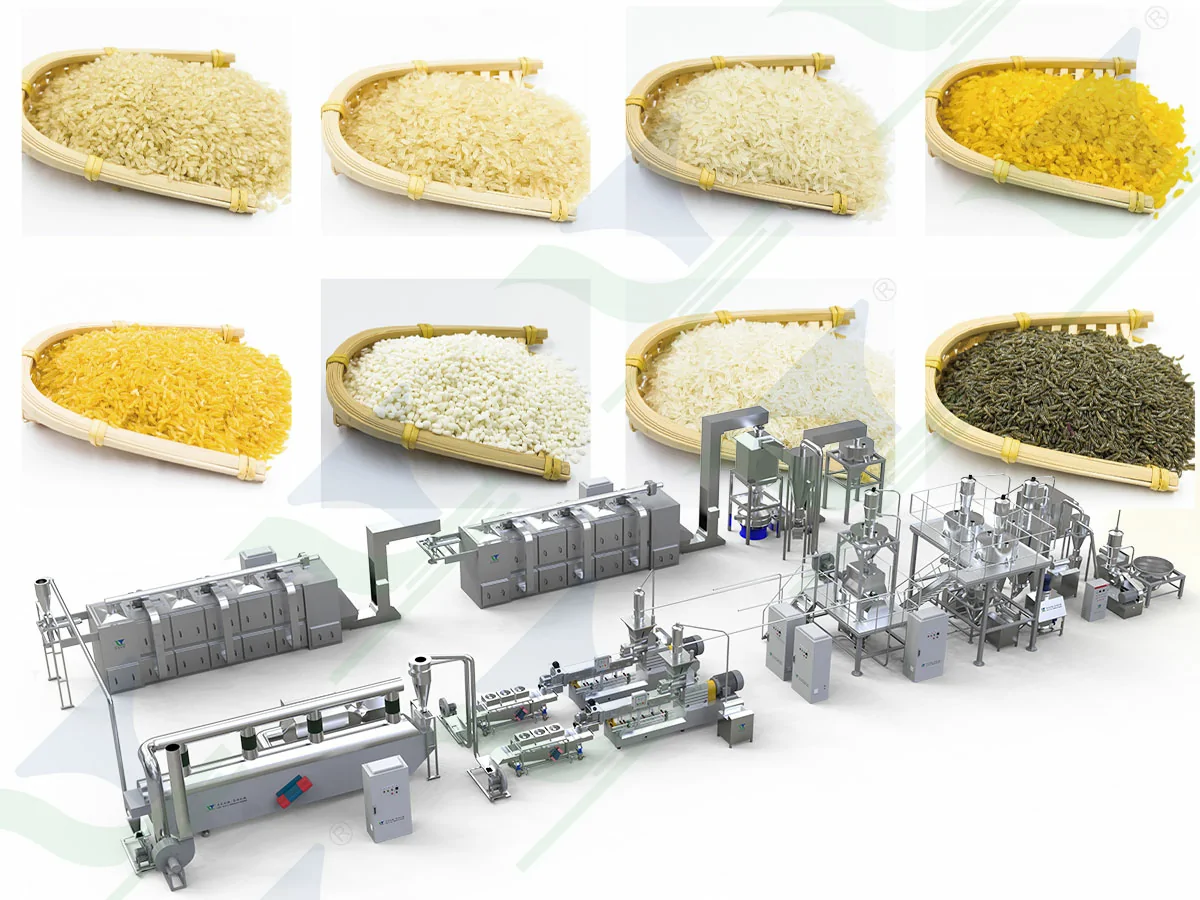
Fortified rice refers to rice that has been enriched with essential micronutrients such as iron, zinc, and vitamins. It is produced by blending fortified kernels with regular polished rice. Industrial-scale production uses extrusion technology to create rice-shaped kernels with precisely measured nutrients. A standard production line includes formulation, mixing, extrusion, drying, cooling, blending, and packaging—ensuring nutritional accuracy, food safety compliance, and suitability for large-scale distribution.
As fortified rice becomes more widely used in government procurement, school meal programs, and humanitarian projects, understanding the actual production process is no longer optional—it directly affects compliance, cost control, and long-term project success.
What Is Fortified Rice?
Fortified rice is enriched with specific micronutrients to address nutritional deficiencies such as iron-deficiency anemia and zinc deficiency. Unlike natural rice, fortified rice is carefully engineered to ensure controlled and measurable nutrient content in every serving.
In most large-scale programs, fortified rice is produced by blending fortified rice kernels (FRKs) with regular polished rice at a defined ratio. These kernels are designed to closely match natural rice in size, shape, density, and cooking behavior, making them indistinguishable to consumers during washing, cooking, or eating.
This approach allows fortified rice to integrate seamlessly into existing rice distribution systems without changing consumer habits.
Why Is Fortified Rice Important in Large-Scale Nutrition Programs?
From both policy and engineering perspectives, fortified rice is effective because it targets staple food consumption. According to global nutrition best practices, fortification works best when nutrients are delivered through daily, habitual foods.
Fortified rice is widely adopted because:
• Rice is a staple food in many regions
• Fortification does not alter taste or appearance
• Nutrient dosage can be precisely controlled
• Distribution uses existing rice supply chains
Therefore, fortified rice is commonly used in:
• Government food subsidy programs
• School meal and maternal nutrition programs
• NGOs and humanitarian food aid
• Nutrition-focused commercial rice brands
How Is Fortified Rice Produced?
Industrial fortified rice production is centered on fortified rice kernels, which are manufactured separately and later blended with natural rice.
Hot extrusion is the most widely accepted and scalable method. It embeds micronutrients into the rice matrix rather than applying them to the surface.
Typical raw materials include:
• Rice flour or broken rice flour
• Micronutrient premix (iron, zinc, folic acid, vitamin B12, etc.)
• Water for binding and extrusion
Rice flour is used to maintain similar cooking and sensory properties to natural rice. The micronutrient premix must meet nutritional standards set by public health agencies or project specifications.
From a production standpoint, formulation accuracy is critical. Even a ±5% deviation in dosage can result in non-compliance with regulated nutrition programs.
How Does Extrusion Work in Fortified Rice Production?
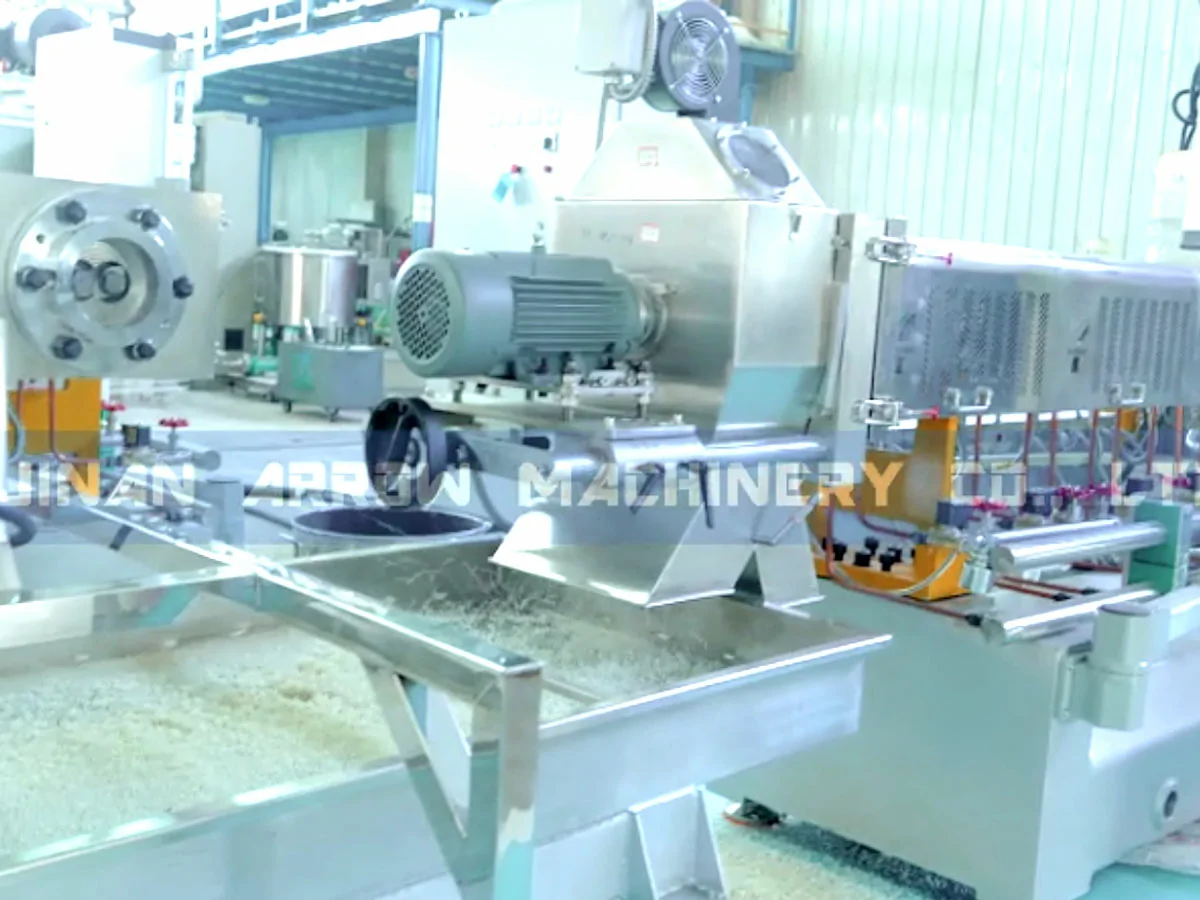
During extrusion, the blended rice flour and micronutrient mixture is fed into an extruder, where heat, pressure, and mechanical shear gelatinize the starch and form rice-like granules.
Typical extrusion parameters include:
• Barrel temperature: approx. 70–110°C
• Moisture content before extrusion: typically 25–35%
• Continuous low-shear extrusion to preserve nutrient stability
Hot extrusion is favored because it:
• Locks micronutrients within the starch structure
• Produces mechanically stable kernels
• Allows precise control over kernel shape, length, and density
Mold design is critical. Fortified kernels must visually match natural rice to prevent separation during mixing and transport.
Why Are Drying and Moisture Control Critical?
After extrusion, the fortified kernels contain excess moisture and must be dried for long-term stability.
Target post-drying moisture content is typically:
• Around 10–12%, depending on storage and climate conditions
Drying serves several purposes:
• Prevents microbial growth
• Extends shelf life
• Provides sufficient mechanical strength for mixing
Over-drying can make kernels brittle and prone to breakage; under-drying increases the risk of mold. Industrial production lines typically use multi-zone continuous dryers to ensure consistent results.
How Are Fortified Kernels Mixed with Regular Rice?
After drying and cooling, fortified kernels are blended with polished rice at set ratios such as:
• 1:50 (2% fortified kernels)
• 1:100 (1% fortified kernels)
Industrial mixing systems are designed to maintain consistent blending even at high throughput. Uniform kernel size and density are essential to avoid separation during handling and packaging.
From an engineering perspective, blending accuracy directly impacts the final product’s nutritional consistency.
How Is Extruded Fortified Rice Different from Coated or Dust-On Rice?
Extruded fortified kernels differ fundamentally from coated or dust-on rice.
Extruded fortified rice:
• Retains nutrients after washing and cooking
• Delivers stable nutrient doses
• Is accepted by government and NGO programs
Coated or dust-on rice:
• Loses nutrients during rinsing
• Has inconsistent nutrient dosing
• Is generally unsuitable for regulated large-scale distribution
This is why extruded fortified rice is considered the industry standard for public nutrition programs.
What Are the Main Challenges in Fortified Rice Production?
Based on industrial practice, fortified rice production involves several technical challenges:
Nutrient Stability:
Some vitamins are sensitive to heat and moisture, requiring tight control of extrusion and drying conditions.
Visual and Physical Consistency:
Kernels must closely resemble natural rice to ensure blending stability and consumer acceptance.
Dosage Accuracy:
Strict formulation and blending control is required to meet nutritional specifications.
Process Integration:
Fortified rice production is a system process involving formulation, extrusion, drying, and blending—not just a single machine operation.
Who Typically Invests in Fortified Rice Production Lines?
Fortified rice lines are commonly used by:
• Rice millers upgrading to higher-value processing
• Government-supported food processors
• NGOs and humanitarian suppliers
• Nutrition-focused food manufacturers
For these stakeholders, compliance, reliability, and long-term operational stability often matter more than maximum output.
Conclusion
Fortified rice is a technologically engineered food product designed to deliver essential nutrients at scale. It is not simply rice with added vitamins—it is the result of precise formulation, controlled extrusion, careful drying, and accurate blending.
For manufacturers and project owners, understanding the production process is essential for choosing the right technology, meeting regulatory requirements, and ensuring consistent nutritional outcomes in large-scale programs.
Meta Title
What Is Fortified Rice and How Is It Produced? | Manufacturing Guide
Meta Description
Learn what fortified rice is and how it is produced using extrusion technology, including formulation, drying, blending, and compliance for large-scale nutrition programs.

 EN
EN