 EN

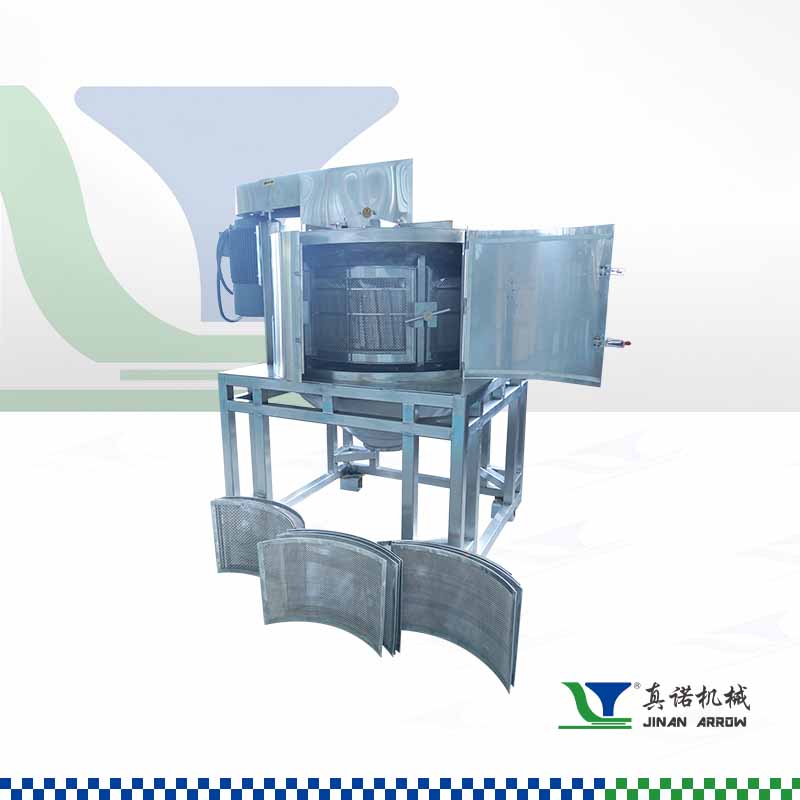
Milling Screen Selection for Targeted Particle Size Control
Hammer mill screen mesh size and its direct impact on granulation range
In a bread crumb machine, hammer mill screen mesh size is the primary mechanical lever for granulation range control. The screen acts as a classification barrier: particles remain in the grinding chamber until they are small enough to pass through the perforations. Smaller mesh openings increase retention time and impact frequency, shifting the entire particle size distribution (PSD) toward a finer, narrower range; larger openings allow coarser crumbs to discharge sooner, yielding a wider size band and higher throughput. Fine screens (0.8–1.5 mm) support dusting and batter mixes, while 3–5 mm screens produce coarse crumb for toppings and fillings. Critically, this relationship holds independently of rotor speed—changing only the screen perforation shifts the PSD curve, as confirmed by conical and hammer mill processing data from industry-standard milling trials.
Worn or stretched screen holes are a common source of distribution drift, permitting oversized particles to bypass the intended aperture. Routine inspection and replacement therefore stabilize granulation, reduce rework, and maintain downstream sieving efficiency. For sub-millimeter uniformity—such as ultra-fine coating crumb—operators often pair the main screen with a secondary fine screen to limit excessive fines and ensure batch-to-batch consistency.
Grinder screen compatibility for application-specific crumb profiles (coating vs. panko)
Crumb applications demand more than just different aperture sizes—they require purpose-built screen configurations. Coating crumbs need fine, uniform particles that adhere evenly during frying or baking, achieved using smooth perforated screens with tight clearances and apertures of 0.5–1.5 mm. In contrast, panko-style crumbs rely on large, irregular, flaky structures that trap air and deliver crisp texture—requiring wider mesh or slotted screens paired with reduced grinding intensity to preserve delicate morphology. Using a fine coating screen for panko destroys its open, needle-like structure; conversely, running coating crumb through a panko-configured screen generates excessive fines and poor visual texture.
Screen thickness, open area percentage, and perforation shape all influence how the mill fractures dry bread—not just how much it reduces it. A compatible configuration minimizes recirculation, improves yield, and maintains stable, application-specific granulation ranges across continuous production.
| Crumb profile | Screen configuration | Typical aperture | Desired result |
|---|---|---|---|
| Coating | Smooth perforated, tight clearance | 0.5–1.5 mm | Fine, uniform adhesion |
| Panko-style | Wider mesh or slotted, reduced intensity | 2.0–5.0 mm | Airy, irregular, flaky |
Mechanical Grinding Parameters: Speed, Blade Design, and Aperture Adjustment
Blade rotational speed and configuration effects on crumb fineness and uniformity
Blade rotational speed directly governs the shear and impact energy applied to dry bread in the grinding chamber. Higher tip speeds increase cutting events per second, producing finer, more uniform crumbs. A 2023 milling study found that raising rotor speed from 2,400 to 3,600 rpm reduced median crumb diameter (D50) by 18% and tightened the distribution range—without altering screen size. Blade configuration further refines output: straight knife blades deliver clean cuts ideal for controlled fines; hammer blades apply high-impact force suited to brittle, coarse bread; and pin mill rotors enhance dispersion for delicate coating applications.
Blade angle, count, and rotor-to-stator clearance must be matched to feed moisture and hardness. Operators can therefore shift the granulation curve—finer or coarser—by adjusting speed or swapping blade sets, avoiding screen changes entirely. Uniformity degrades rapidly with blade wear: dull edges cause uneven tearing and oversize flakes. Monitoring wear and maintaining sharp, calibrated blades ensures consistent particle control. A moderate tip speed typically delivers the optimal balance between throughput and sizing precision.
Real-time aperture and gap adjustment for dynamic particle size control in bread crumb machines
Real-time aperture and gap adjustment enables on-the-fly particle size shifts without halting production. By moving the screen or adjusting the rotor-stator gap, operators change the physical distance a particle must travel before escaping the grinding zone. Smaller gaps increase recirculation and produce finer output; larger gaps permit earlier discharge of coarser material. In automated lines, servo-driven gap settings integrate with load sensors and sieve feedback loops for responsive, closed-loop control. Benchmark data from 2022 milling trials showed that narrowing the gap from 1.5 mm to 0.8 mm shifted D50 from 2.0 mm to 1.1 mm within 90 seconds—demonstrating robust dynamic control across coating-grade and panko-grade specifications.
Stable gap geometry is essential: thermal expansion or vibration-induced drift as small as 0.2 mm alters crumb texture and repeatability. Regular calibration and position feedback systems preserve accuracy. This capability eliminates manual screen changes, significantly reducing downtime and supporting rapid recipe transitions.
Post-Milling Classification: Vibratory Sieving and Distribution Consistency
Post-milling classification converts mill output into repeatable, specification-compliant particle size bands—preventing oversize and fines from reaching final product.
Vibratory sieve system operation and its role in achieving precise, repeatable crumb sizing
A vibratory sieve system separates crumb by oscillating material across a screen deck. Adjustable amplitude, frequency, and deck angle control residence time and stratification, giving particles repeated opportunities to pass through the mesh. Multi-deck configurations remove oversize on the top screen and fines on the lower screen, isolating the target middle fraction. Closed-loop drives maintain steady stroke and frequency—minimizing drift over extended runs. For coating-grade crumb, a typical stack of 1.6 mm over 0.8 mm yields a consistent 0.8–1.6 mm cut; for panko, a 2.0 mm over 1.0 mm stack better preserves flakiness. Integrated screen cleaning devices prevent blinding when crumb carries slight residual moisture—ensuring sustained separation performance. Because sieving is the final gate before packaging, these settings define the ultimate precision and repeatability of crumb sizing.
Sieve analysis protocols for validating particle size distribution against specification
Sieve analysis validates that classified crumb meets target particle size distribution (PSD). A representative sample is dried to a standardized moisture level (typically ≤6%), weighed, and placed on a certified sieve stack matching production mesh sizes. The stack is shaken at fixed amplitude and duration—commonly 5 minutes—to ensure consistent separation. Retained mass on each sieve is weighed and expressed as a percentage of total sample mass. Operators track D10, D50, and D90 values and compare them against control limits—for example, D50 between 1.0 mm and 1.4 mm for panko-style crumb. If results deviate beyond ±5% of target, adjustments are made to milling screens or vibratory settings before packed product is affected—enabling proactive quality control.
Upstream Process Integration: How Feed Preparation Affects Final Sizing Efficiency
Feed preparation sets the practical upper limit for particle size control in a bread crumb machine. Oversized, irregular bread pieces force the mill to achieve greater size reduction in a single pass—broadening the PSD and increasing both oversize flakes and dust. Pre-breaking slabs or routing crust edges through a coarse pre-grinder establishes a controlled top size (≤5 mm), keeping the main mill within its design reduction ratio and improving repeatability. Moisture content is equally decisive: feed above 8–10% moisture risks starch smearing and screen blinding, while feed below 6% becomes overly brittle and generates excess fines. Field comparisons from 2023 show that lines conditioning feed to a narrow 6–8% moisture band before milling consistently produce more stable crumb profiles than those milling directly from ambient storage.
| Upstream factor | Typical effect on final crumb sizing | Process control action |
|---|---|---|
| Oversized feed pieces | Higher screen load, broader PSD, more overs | Pre-break to ≤5 mm or use two-stage reduction |
| Moisture variation | Screen blinding when wet, excess fines when dry | Condition to 6–8% moisture before milling |
| Uneven feed rate | Surging, variable residence time, inconsistent sizing | Use metered feeder and level control |
Even a perfectly configured bread crumb machine cannot compensate for unstable feed flow. Slugs of material cause momentary overloads that stall rotor speed and widen the size distribution. Uniform metering—via vibratory feeders or rotary valves regulated by level sensors—maintains steady grinding load. An upstream scalping screen also removes fines and small fragments that would otherwise pass too quickly through the mill and contribute to dust. These upstream controls reduce rework, extend screen life, and make final particle size control significantly more predictable.
FAQ
What is the impact of hammer mill screen size on crumb texture?
Hammer mill screen size determines the granulation range of bread crumb. Smaller openings create finer particles and tighter distributions suited for batter mixes, while larger apertures allow for coarser crumbs ideal for toppings.
How does rotor speed affect particle size in bread crumb machines?
Increasing rotor speed raises shear and impact energy, producing finer, more uniform crumbs. Rotor speed adjustments can refine the crumb profile without changing the screen size.
What are the recommended crumb screen configurations for coating and panko applications?
For coating crumbs, smooth perforated screens with apertures of 0.5–1.5 mm deliver fine, uniform adhesion. For panko-style crumbs, wider mesh or slotted screens with apertures of 2.0–5.0 mm produce airy, flaky structures.
How does feed moisture content impact crumb sizing efficiency?
Moisture levels below 6% lead to excessive fines, while levels above 8% cause screen blinding. Conditioning feed to a narrow moisture range of 6–8% optimizes repeatability and crumb stability.
What is vibratory sieve analysis and how does it validate crumb sizing?
Sieve analysis involves weighing retained mass on a sieve stack to ensure PSD compliance. Operators track D50 and related values to optimize milling and sieving precision.
Table of Contents
- Milling Screen Selection for Targeted Particle Size Control
- Mechanical Grinding Parameters: Speed, Blade Design, and Aperture Adjustment
- Post-Milling Classification: Vibratory Sieving and Distribution Consistency
- Upstream Process Integration: How Feed Preparation Affects Final Sizing Efficiency
-
FAQ
- What is the impact of hammer mill screen size on crumb texture?
- How does rotor speed affect particle size in bread crumb machines?
- What are the recommended crumb screen configurations for coating and panko applications?
- How does feed moisture content impact crumb sizing efficiency?
- What is vibratory sieve analysis and how does it validate crumb sizing?