 EN
EN

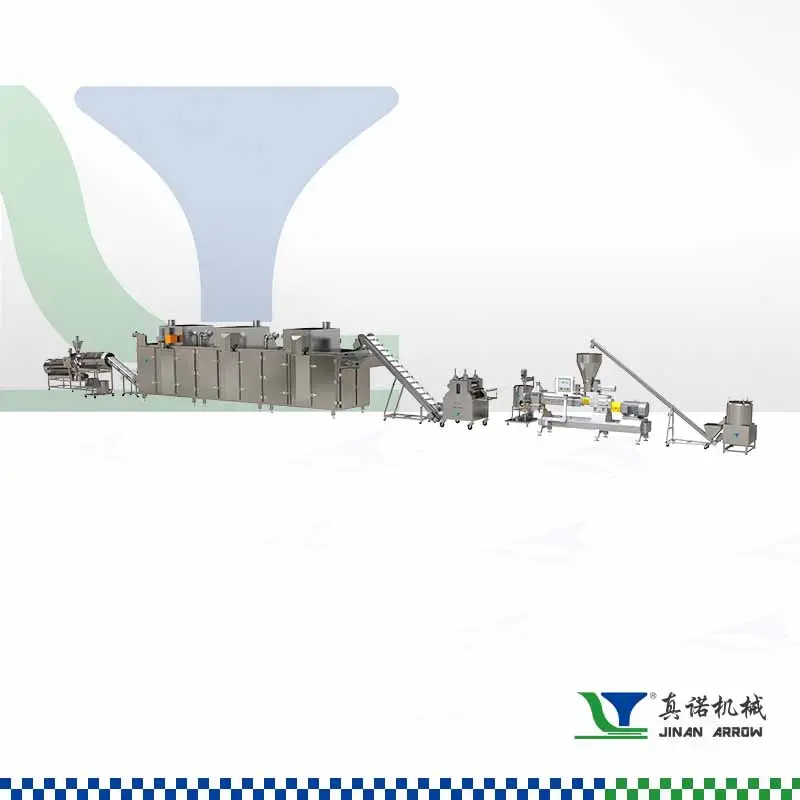
The Shape Imperative in the Snack Market
In the highly competitive snack industry, product shape is not merely decorative — it is a strategic differentiator that influences consumer perception, eating experience, and even pricing power. Whether it is the spiral of a fusilli-style pellet, the triangle of a tortilla chip, the pillow of a filled snack, or the three-dimensional geometry of a 3D pellet, each shape creates a distinct mouthfeel and visual identity. For industrial buyers evaluating a snack pellet production line, the ability to produce diverse shapes from a single line is a critical purchasing criterion. Understanding how die design, extrusion parameters, cutting mechanisms, and post-extrusion forming equipment work together to create shape variety is essential for making informed equipment decisions.
Die Configuration: Where Shape Begins
The die is the primary shape-defining component in any snack pellet production line. At its simplest, a circular die opening produces cylindrical pellets that can be sliced into discs. However, modern twin-screw extrusion lines achieve far greater variety through custom die inserts — star-shaped, triangular, wavy, ring-shaped, and multi-lobed profiles are all produced at the die face. The die design must balance creative shape ambition with practical processing constraints: die openings that are too narrow or too complex can cause excessive back pressure in the extruder barrel, reducing throughput and increasing energy consumption. A well-designed die plate with multiple identical openings of the target shape distributes flow evenly across all openings, maintaining consistent pellet dimensions. For operations producing multiple pellet varieties, quick-change die systems that allow die plate swaps in under 15 minutes without cooling down the barrel are a valuable productivity feature.
Cutting Systems: Defining Pellet Length and Face Quality
While the die determines the cross-sectional shape, the cutting system determines pellet length and face quality. The most common configuration in a snack pellet production line is a face-cutting mechanism — rotating blades mounted directly at the die face that slice pellets to the desired length as they emerge. Blade speed relative to extruder output rate is the primary control for pellet length: faster rotation produces shorter pellets, slower rotation produces longer ones. The number of blades on the cutter head also matters: a 2-blade head produces longer pellets than a 6-blade head at the same rotational speed. Beyond simple length control, specialized cutting systems enable distinctive shapes. Angled blades can produce parallelogram cross-sections from round dies. Intermittent cutting — where blades engage and disengage on a programmable cycle — can create pillow-shaped or elongated forms. For 3D pellet snacks that require post-extrusion expansion in hot oil, precise cutting is critical because the pellet dimensions directly determine the final expanded shape after frying.
Post-Extrusion Forming: Beyond the Die Face
After extrusion and cutting, several post-extrusion forming steps can further diversify pellet shapes before drying or frying. A flaking or sheeting machine — rollers that press the still-warm pellets into thin, flat discs — transforms cylindrical pellets into round chips, which is the basis for tortilla-style and potato-chip-style snacks. Four-roller forming machines and compound forming machines can create more complex geometries by pressing pellets between shaped rollers, producing products like Bugles (cone shapes) or pillow-shaped filled snacks. The sequence matters: some manufacturers extrude a continuous sheet rather than individual pellets, then use rotary cutters to stamp out shapes such as triangles, squares, or custom outlines. This approach is common for Doritos-style tortilla chips produced on a snack pellet production line configured for sheet-forming rather than individual pellet extrusion.
Recipe and Process Parameter Effects on Shape Fidelity
The extruded dough formulation significantly affects how well a pellet holds its intended shape. Starch content, moisture level, and protein content all influence dough elasticity and die swell — the tendency of the extruded material to expand slightly upon exiting the die. High-amylose starches produce dough with lower die swell and better shape retention, making them preferable for intricate die shapes that must hold sharp edges. Moisture content in the 15-22% range typically provides the best balance of flowability and shape stability for pellet extrusion. Barrel temperature profiles also affect shape fidelity: a gradual temperature ramp from 80°C in the feeding zone to 150°C near the die promotes uniform melting without causing premature expansion that would distort the shape at the die exit. The screw configuration — specifically the ratio of conveying elements to kneading blocks — must be tuned for each product type, as excessive shear can degrade the starch matrix and cause post-extrusion shape deformation.
Application Example: A Multi-Shape Pellet Operation
A snack manufacturer in Latin America operating a single snack pellet production line needed to serve three distinct retail channels, each demanding different pellet geometries: a budget brand requiring simple cylindrical pellets for private-label corn snacks, a mid-tier brand needing spiral-shaped 3D pellets for a premium fried snack, and an export brand requiring triangular chips for a nacho-style product. The solution involved a twin-screw extruder with a quick-change die system, a variable-speed face cutter with interchangeable blade heads (2-blade, 4-blade, and 6-blade), and a downstream module that could be configured for either direct drying or sheet-forming with rotary cutters. By organizing production into weekly batch runs, the manufacturer was able to produce all three shapes on the same line with changeover times of approximately 45 minutes between product types. The die and cutter head were changed for each product, while the screw configuration and temperature profile were saved as distinct recipes in the extruder's programmable controller — which held up to 24 sets of parameters.
Selecting a Production Line for Shape Flexibility
When evaluating a snack pellet production line for shape diversity, buyers should prioritize four features. First, the extruder should support quick-change die systems and have sufficient barrel length to accommodate different screw configurations for different product types. Second, the cutting system should offer variable-speed control and interchangeable blade heads, with programmable intermittent cutting if pillow or elongated shapes are in the product roadmap. Third, post-extrusion forming modules — flakers, four-roller formers, rotary cutters — should be designed for rapid reconfiguration or bypass when not needed. Fourth, the control system should store and recall complete recipe parameters, including barrel temperatures, screw speed, feed rate, cutter speed, and forming roller settings, to minimize changeover time and reduce operator error.
Table of Contents
- The Shape Imperative in the Snack Market
- Die Configuration: Where Shape Begins
- Cutting Systems: Defining Pellet Length and Face Quality
- Post-Extrusion Forming: Beyond the Die Face
- Recipe and Process Parameter Effects on Shape Fidelity
- Application Example: A Multi-Shape Pellet Operation
- Selecting a Production Line for Shape Flexibility