 EN
EN

How Food Extruder Temperature Impacts Nutrient Retention and Bioavailability
Degradation of heat-sensitive nutrients: vitamins (B1, C), lysine, and antioxidants
Controlling thermal energy input in a food extruder directly determines the final nutritional profile. Heat-sensitive micronutrients degrade rapidly when barrel temperatures exceed optimal thresholds. Thiamine (Vitamin B1) and ascorbic acid (Vitamin C), for example, exhibit significant losses above 130°C—particularly in the high-moisture, high-shear environment of the extruder barrel. A leading industry study found that a 10°C increase in barrel temperature accelerated Vitamin C degradation by 15% (Industry data, 2023).
Lysine—the limiting amino acid in many grain-based formulations—is especially vulnerable. At elevated temperatures, its free amino group reacts with reducing sugars via the Maillard reaction, forming indigestible complexes. Lysine retention remains above 90% at 120°C but can fall below 70% when mass temperature exceeds 160°C. Similarly, natural antioxidants—including tocopherols and polyphenols—lose 20–40% of their total capacity under intense extrusion conditions, compromising both nutritional value and shelf stability. Precise temperature profiling is therefore essential: the same thermal energy that gelatinizes starch can systematically degrade the most fragile and biologically valuable components.
Protein denaturation, Maillard reactions, and antinutritional factor inactivation (e.g., trypsin inhibitors)
Extruder temperature governs a critical balance: moderate heat improves protein digestibility through controlled denaturation—unfolding tertiary structures to expose peptide bonds for enzymatic cleavage—while excessive heat triggers destructive Maillard reactions that bind lysine to carbohydrates, yielding non-digestible complexes and misleadingly high crude protein readings.
Thermal control is equally vital for inactivating heat-labile antinutritional factors. Raw soybeans, for instance, contain trypsin inhibitors that impair protein digestion in monogastric animals. Effective inactivation requires sustained exposure to 130–140°C—a threshold reliably achieved under high-temperature, short-time (HTST) extrusion. According to the 2024 Feed Ingredient Insights, this targeted thermal treatment significantly enhances feed nutritional quality. The operational challenge lies in hitting this narrow window: too low, and inhibitors persist; too high, and irreversible amino acid damage occurs—even if microbial safety is assured.
Food Extruder Temperature Control Determines Product Safety and Shelf Stability
Precise temperature control serves as the primary barrier against microbial hazards. The HTST process must consistently reach the thermal death point for pathogens such as Salmonella and Listeria. Research shows that even a 2°C drop in die temperature can reduce lethality against heat-resistant spores by up to 30% (Food Control, 2020). Beyond pathogen kill, temperature also governs inactivation of endogenous enzymes—including lipoxygenase and peroxidase—that catalyze lipid oxidation and off-flavor development during storage.
By ensuring uniform thermal exposure across the entire extrudate mass, manufacturers achieve low water activity and stable physical structure—key prerequisites for ambient shelf stability. This eliminates reliance on refrigeration or chemical preservatives, extending commercial life while preserving sensory and functional attributes.
Food Extruder Temperature Uniformity Drives Consistent Extrudate Quality and Appearance
Uniform temperature distribution across the extruder barrel and die is non-negotiable for consistent texture, color, density, and expansion. Minor thermal gradients alter melt viscosity, causing uneven expansion, surface defects, and structural variability. In direct-expanded snacks, for example, inconsistent heating yields some pieces overly dense and others excessively fragile—directly undermining consumer acceptance and shelf life.
Modern multi-zone heating and cooling systems—paired with real-time, zone-specific temperature sensors—enable operators to maintain tight thermal tolerances. This ensures the melt exits the die at consistent temperature and rheology, batch after batch. The result is reduced reject rates, lower waste, and enhanced brand reliability: uniform temperature control is not merely technical hygiene—it’s a strategic differentiator in competitive food markets.
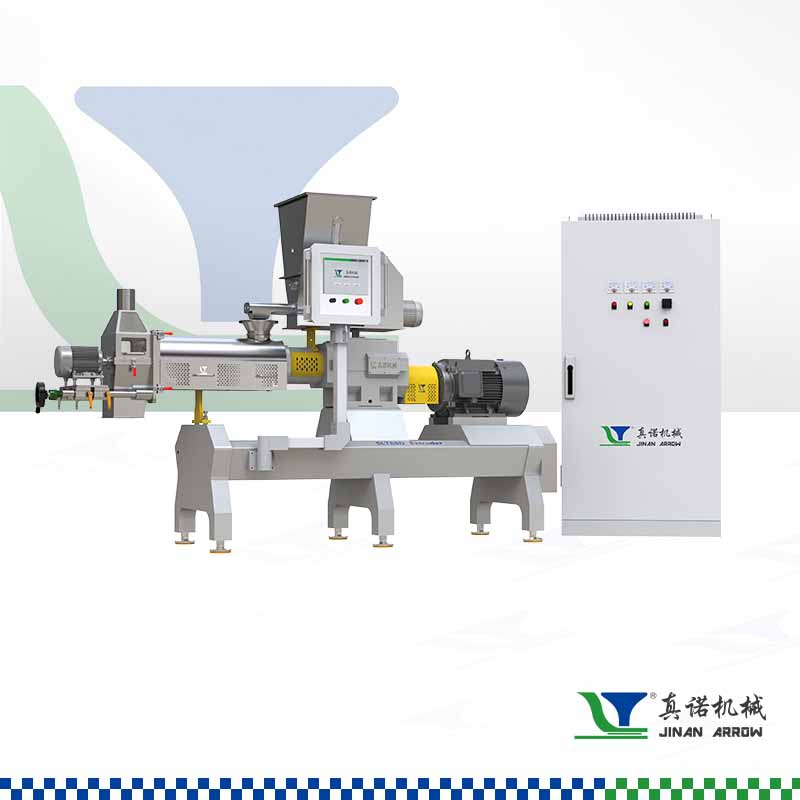
Optimizing Food Extruder Temperature for Balanced Performance
Strategic trade-offs: lower temperature vs. residence time, moisture, and screw speed
Optimal extrusion demands careful navigation of interdependent variables. Lowering barrel temperature preserves heat-sensitive nutrients but risks incomplete starch gelatinization—compromising digestibility, expansion, and structural integrity. To compensate, operators adjust residence time, moisture, and mechanical energy input in concert:
| Parameter | Consequence of Lower Temperature | Typical Counterbalance |
|---|---|---|
| Residence time | Insufficient cooking; low gelatinization | Increase by reducing feed rate or screw speed |
| Moisture content | Higher moisture enhances gelatinization at lower temperatures but may weaken pellet integrity | Carefully raise to 25–30%, monitoring expansion and density |
| Screw speed | Reduced shear heating lowers mechanical energy input | Decrease to 250–350 rpm to extend residence time without overloading torque |
Industry benchmarks indicate that 80–95% starch gelatinization in twin-screw extruders is typically achieved within 120–160°C, 20–30% moisture, and 250–500 rpm. Operating at the lower end of this range requires synchronized parameter tuning—not isolated adjustments—to uphold food safety, nutrient retention, and throughput.
Real-time monitoring and closed-loop control systems for precision food extruder operation
Advanced PLC-based control systems are now standard for high-performance extrusion. These continuously monitor melt temperature, die pressure, motor load, and specific mechanical energy—and automatically adjust heating zones, screw speed, or feed rate to maintain target process windows. Such responsiveness is essential: raw material variability (e.g., fluctuating moisture or protein content) can shift thermal equilibrium within minutes.
Closed-loop control prevents hot spots that degrade nutrients and cold zones that leave starch undercooked or pathogens viable. Integrated sensor networks also support full batch documentation for traceability and compliance. The outcome is reproducible extrudate quality, improved nutrient retention, reliable shelf stability, and reduced operator dependency—transforming temperature management from reactive troubleshooting into proactive, data-driven optimization.
FAQ
What nutrients are most affected by high food extruder temperatures?
Heat-sensitive micronutrients such as vitamins B1 (thiamine), C (ascorbic acid), lysine, and natural antioxidants are most vulnerable to degradation at high extruder temperatures.
What is the role of temperature in microbial safety during extrusion?
Controlled temperature ensures the thermal death of pathogens like Salmonella and Listeria, improving microbial safety and overall product shelf stability.
How can extrusion parameters be adjusted if a lower temperature is desired?
Operators can compensate for lower temperatures by increasing residence time, carefully raising moisture content, or reducing screw speed to balance cooking, expansion, and integrity.
How does uniform temperature contribute to product quality?
Uniform temperature ensures consistent texture, color, density, and expansion, minimizing reject rates and enhancing consumer satisfaction.
What technologies support precise temperature control?
PLC-based control systems and real-time temperature monitoring enable automated adjustments and consistent extrusion quality.
Table of Contents
- How Food Extruder Temperature Impacts Nutrient Retention and Bioavailability
- Food Extruder Temperature Control Determines Product Safety and Shelf Stability
- Food Extruder Temperature Uniformity Drives Consistent Extrudate Quality and Appearance
- Optimizing Food Extruder Temperature for Balanced Performance
-
FAQ
- What nutrients are most affected by high food extruder temperatures?
- What is the role of temperature in microbial safety during extrusion?
- How can extrusion parameters be adjusted if a lower temperature is desired?
- How does uniform temperature contribute to product quality?
- What technologies support precise temperature control?