 EN
EN

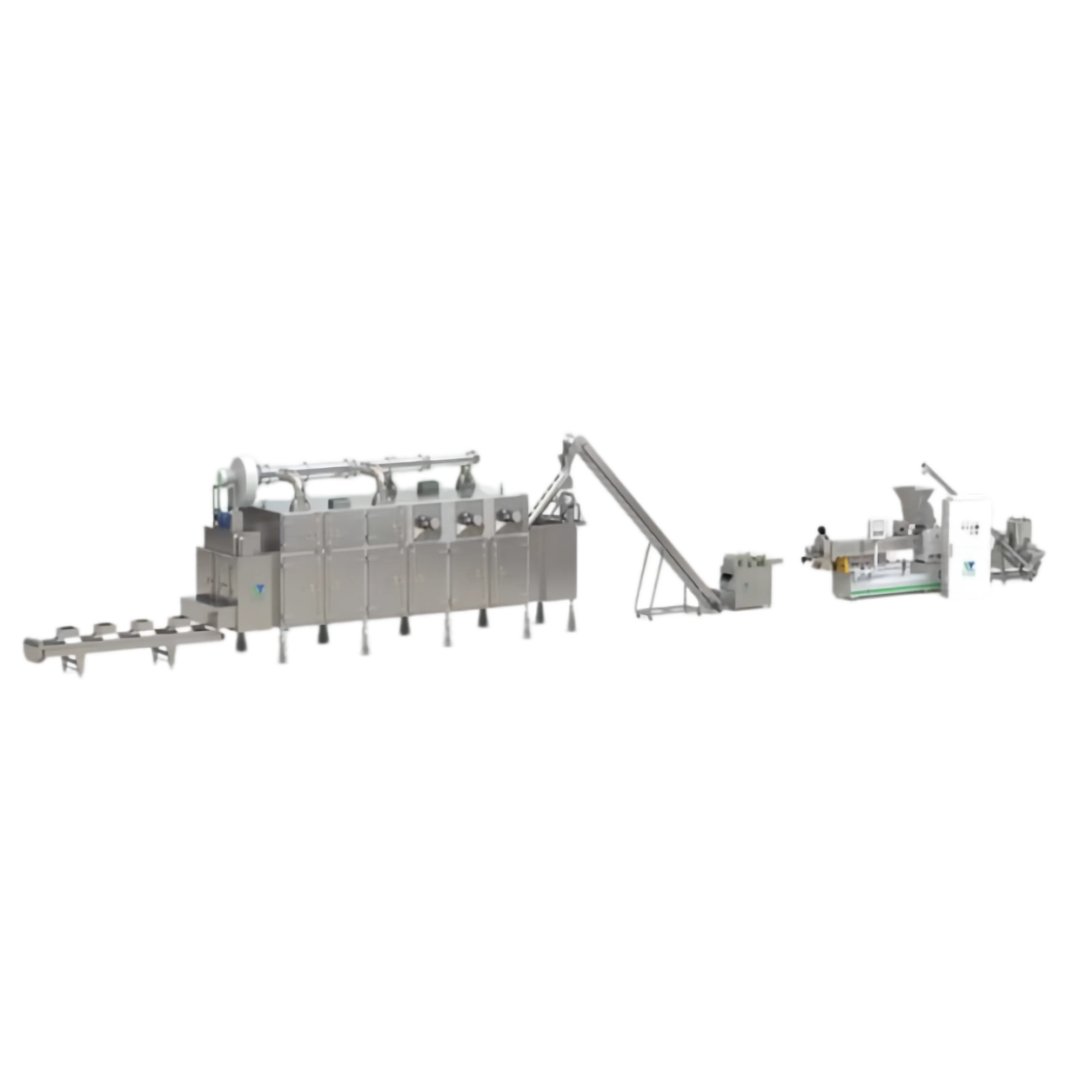
Why Twin Screw Technology Matters in Modern Food Processing
Food extrusion has evolved from a simple shaping technology into a sophisticated thermal-mechanical processing platform that cooks, mixes, textures, and forms products in a single continuous operation. At the center of this evolution is the twin screw food extruder, which has become the preferred choice for manufacturers producing everything from breakfast cereals and snack pellets to textured vegetable protein, pet food, and modified starches. While single screw extruders remain adequate for basic puffing applications with simple formulations, the twin screw food extruder delivers five fundamental advantages that directly translate to better product quality, higher operational efficiency, and greater manufacturing flexibility. Understanding these benefits helps industrial buyers make informed equipment investments rather than defaulting to the lowest upfront cost option.
Superior Mixing and Homogenization
The most significant advantage of a twin screw food extruder over its single screw counterpart is mixing capability. In a co-rotating twin screw design, the two intermeshing screws create multiple mixing mechanisms — distributive mixing that spreads ingredients evenly throughout the melt, and dispersive mixing that breaks down particle agglomerates and ensures uniform ingredient distribution at the microscopic level. This dual mixing action means that minor ingredients such as vitamins, minerals, colorants, and flavorings are uniformly dispersed in the product matrix, eliminating the hot spots and concentration gradients that plague single screw processing of complex formulations. The screw elements themselves can be arranged along the shaft as a customizable sequence of conveying elements, kneading blocks, and reverse elements, each serving a specific process function. Conveying elements move material forward, kneading blocks apply shear and mixing, and reverse elements create back-pressure for intensive processing at specific barrel locations. This modularity allows food manufacturers to optimize the screw profile for each product rather than compromising with a one-size-fits-all configuration.
Precise and Independent Process Control
A twin screw food extruder provides independent control over multiple process parameters that are coupled in single screw machines. Screw speed, feed rate, barrel temperature (across 4-8 independently controlled zones), and water or steam injection rate can each be adjusted without forcing compensating changes in other parameters. This independence is critical for products with narrow processing windows — for example, the production of high-protein snacks where the extrusion temperature must stay within a 5-10°C band to prevent protein degradation while achieving complete starch gelatinization. Modern twin screw extruders with touch screen PLC control systems, such as those storing up to 24 parameter sets, enable operators to recall validated recipes with a single command, dramatically reducing changeover time and eliminating the trial-and-error that consumes raw materials and production hours during product transitions. The data logging capability built into these control systems also supports quality documentation for HACCP and ISO 22000 compliance, providing a verifiable record that each batch was processed within specification.
Wide Raw Material Flexibility
A twin screw food extruder can process an exceptionally wide range of raw materials — from low-moisture cereal flours and high-protein soy meals to high-fat formulations and high-fiber ingredients that would cause slippage and throughput instability in a single screw machine. The positive displacement conveying action of intermeshing twin screws means that material transport is less dependent on friction between the material and the barrel wall, allowing the extruder to handle oily, sticky, or slippery feedstocks that would stall a single screw. This material flexibility is especially valuable in today's food industry, where manufacturers are increasingly formulating with alternative proteins (pea, chickpea, lentil), ancient grains (quinoa, amaranth, teff), and fiber-rich ingredients that pose processing challenges for simpler extrusion systems. The ability to reconfigure the screw profile by rearranging elements on the shaft means the same twin screw food extruder can be adapted for widely different products — from dense, unexpanded half-product pellets to highly expanded breakfast cereals — by changing the screw configuration and die design rather than investing in a separate machine for each product category.
Energy Efficiency and Reduced Mechanical Wear
While a twin screw food extruder typically has a higher initial purchase price than a comparable single screw machine, the operational cost advantages often reverse this equation within 18-36 months of continuous production. The twin screw design delivers mechanical energy to the material more efficiently because the intermeshing screws create a positive pumping action that does not rely on building high barrel pressure to convey material. This translates to 15-25% lower specific mechanical energy (SME) consumption — the energy input per kilogram of product — for the same throughput. Additionally, the self-wiping screw profile of co-rotating twin screws prevents material from accumulating on screw surfaces and baking onto the metal, which reduces the frequency of cleaning shutdowns and extends screw and barrel life. The barrel liner material choice also affects wear life: alloy steel barrel liners, as used in premium twin screw extruders, resist the abrasive wear caused by high-fiber and high-mineral formulations, maintaining tight screw-to-barrel clearances that are essential for consistent product quality.
Scale-Up Reliability from Lab to Production
For food manufacturers developing new products, the ability to scale from laboratory trials to commercial production without reformulating is a critical benefit of twin screw technology. Lab-scale twin screw extruders — such as the FT36 model operating at 10-50 kg/h — share the same fundamental screw geometry and process principles as production-scale machines running at 1,000-2,500 kg/h. The key scaling parameters — specific mechanical energy, residence time distribution, and product temperature history — can be held constant across scales by adjusting screw speed and barrel temperature profiles to compensate for the geometric differences between lab and production machines. This scale-up reliability dramatically reduces the time and cost of new product development, as formulations validated on a pilot line can be transferred to production with minimal additional optimization. Manufacturers with in-house R&D capabilities, including dedicated food application centers, can offer formulation development and process scale-up as an integrated service, further reducing the risk and timeline for new product launches.
Application Example: Multi-Product Flexibility in a Single Plant
A food processing company in the Middle East that manufactured both breakfast cereals and snack pellets was operating two separate single screw extrusion lines — one for each product category. The cereal line struggled with fiber-enriched formulations that caused throughput fluctuations, while the snack line could not achieve the shape precision required for an export customer's 3D pellet specification. After replacing both lines with a single twin screw food extruder equipped with interchangeable screw configurations and a quick-change die system, the company was able to produce both product categories on the same machine. Production was organized into dedicated weekly blocks: three days for breakfast cereals using a screw profile optimized for high starch gelatinization, and two days for snack pellets using a profile configured for precise shape control. The consolidation reduced factory floor space by 40%, cut total energy consumption by approximately 18%, and most importantly, eliminated the quality issues that had been limiting export sales. The extruder's 24-recipe storage capability allowed operators to switch between product configurations in under one hour, including the die change and screw preheating.
Table of Contents
- Why Twin Screw Technology Matters in Modern Food Processing
- Superior Mixing and Homogenization
- Precise and Independent Process Control
- Wide Raw Material Flexibility
- Energy Efficiency and Reduced Mechanical Wear
- Scale-Up Reliability from Lab to Production
- Application Example: Multi-Product Flexibility in a Single Plant